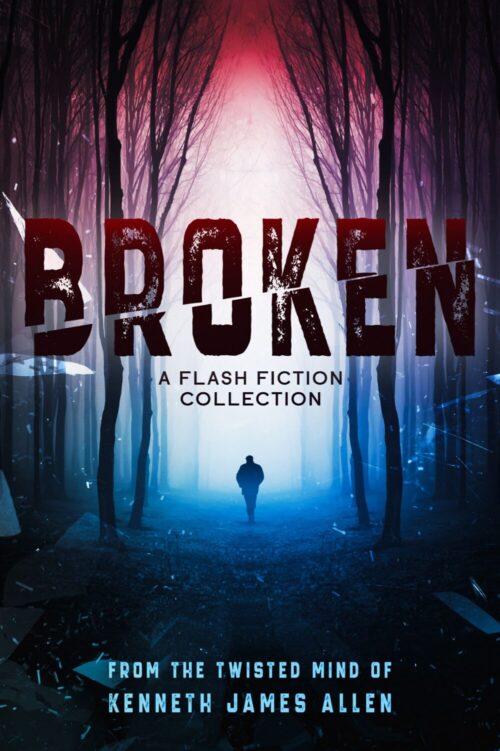
DOWNLOAD YOUR FREE COPY OF BROKEN NOW!
Just enter in your name and email address below and I'll send you a download link
100% privacy guaranteed.
Just enter in your name and email address below and I'll send you a download link
100% privacy guaranteed.
We used to joke about how it would end.
Not us. The world.
On good days, it feels like the same thing.
We played apocalypse roulette the way people play drinking games. Aliens. Zombies. Plague. Meteor. The power grid going down and everyone turning feral inside a week. We watched enough of it to start arguing about the best way to die, quick or brave, as if that was a real choice you could make.
When COVID hit, the shelves emptied and the streets went quiet, and I remember thinking, this is the trailer. This is the opening montage before the real thing. But it passed. Life filled back in. The world pretended it had learned a valuable lesson. Maybe. Maybe not.
It is Saturday in upstate New York, mid-morning. Pale light seeps through the curtains. The heater clicks on, then off. Coffee cools in my hand. Zoe sits beside me on the couch, bare feet tucked under her, my fingers threaded through hers like I can hold the day in place.
We’ve made a rule. One screen. No phones. No scrolling. Just an episode together. Proof we still know how to sit in the same room and be present.
Eight minutes into the final episode of Dark, I pause and glance at Zoe.
“Do you remember who that person was related to?”
Zoe turns toward me, lips parting to answer.
The TV goes black. Not a fade. Not a gentle power save. A hard blink. Like someone cuts the world with scissors.
Silence drops into the room. The fridge stops humming. The heater doesn’t click back on. The faint little noises that say a house is alive, all of them vanish at once.
I sit there, waiting for a beep, a reset, anything.
Nothing.
“What the fuck?” I say, softer than I mean to.
Zoe stares at the dead screen. “What happened to the battery?”
It’s a great question. We built this house to ride out power outages. Battery backup. Automatic transfer. A quiet promise that no matter what the grid does, we stay upright.
I stand. My phone is already in hand. I hate that reflex, but I use it anyway.
The torch flares. The hallway looks normal in that harsh white circle, but normal has already started slipping away.
“I’ll check it out,” I say. “You go online and see if you can find anything out.”
Zoe nods. She reaches for her phone.
I head for the garage.
The cold hits first. Not outside cold. The damp chill of a space that should have a low, constant hum. The battery cabinet sits where it always does, clean lines, status panel dead. The inverter should be clicking. It isn’t.
I step closer. I wait, like the system might wake if I give it a second.
It doesn’t.
I open the main panel.
Every breaker is down.
All of them.
That shouldn’t happen. Not like this. Not unless something hits hard enough to trip everything at once, or the safety logic is screaming that turning anything on is a terrible idea.
I push the main breaker up.
Click.
It holds for half a second, then snaps down again. A sharp flick that feels like the house saying no.
I try again. Same result. Up, then off.
I stop.
I listen.
Nothing. No beep. No fan. No relay. No fault light. No smell of burning plastic. Nothing that fits into a normal Saturday problem.
The system is dead, and it is refusing to come back.
I close the panel. My hand stays on the metal for a beat, like it might tell me what it knows.
It stays silent.
I head back inside. I kill the torch. My phone screen looks bright and smug in the dark, full battery, correct time, like the world outside still exists.
“Any luck?” Zoe calls from the living room.
I find her where I left her. She’s holding her phone like it’s a lifeline.
“No. You?”
“Nope. Website just crashes. Doesn’t even load.”
I take my phone out and try anyway. Habit. Hope. Denial.
A page tries to load, then fails. Then another. Then a simple search. Nothing. No connection. No comforting symbols. It’s like flight mode, but I haven’t touched a setting.
Zoe’s jaw tightens. “So. What do we do?”
I sit and try to pretend my coffee still matters. I lean back and close my eyes like I can bully the day into behaving.
“When the power comes back,” I say, “I’ll have a better idea.”
Zoe doesn’t laugh. She doesn’t roll her eyes. She just watches me, waiting for the part where I admit I don’t know.
“Best case,” I add, “everything fixes itself. Worst case, we call an electrician, pay three hundred bucks for flicking a few switches.”
The silence that follows feels heavier than the outage.
Zoe speaks quietly. “How long do you think it will be?”
I want to say minutes. I want to say it’s nothing. I want to say the grid burps and shrugs and we move on.
Instead I pick a number that sounds reasonable.
“Maybe an hour,” I say. “Two tops.”
Zoe nods, but her eyes drift toward the window. Like she expects to see something that matches the feeling in her chest.
“So,” she says. “What do you want to do?”
I shrug. I hate how small that gesture feels. “I don’t know. Any thoughts?”
Zoe’s voice goes light in a way I know well.
“Oh,” she says. “I’ve got a few ideas.”
I crack one eye at her. She raises an eyebrow, slow and deliberate, then places her cup on the coffee table with care, like manners still matter in a powerless world.
“I’m just going to put away the laundry,” she says, and stands.
She doesn’t need to tell me twice.
I push off the couch and follow her toward the stairs.
Then a sound threads through the stillness.
Not a bang. Not an explosion. A thin, wavering alarm.
One car, somewhere down the road.
Then another.
Then a brief chorus, confused and fading, like the neighborhood wakes up after a big night and can’t remember why it’s angry.
Zoe stops at the bottom stair. Her head tilts.
I stop beside her, listening.
The alarms die away. The quiet returns, but it doesn’t feel like calm anymore. It feels like something holding its breath.
“Car alarms,” I say.
Zoe doesn’t answer.
I head for the front window. The living room is dim now, lit only by stray light through glass. The sky has changed, darker now, overcast. Outside, the street sits in place like a photograph. A couple of cars parked. A bin on the curb. Nothing on fire. No smoke. No screaming.
Then a figure appears two houses down.
A man steps onto his porch, phone in hand. He lifts it to his ear. He lowers it. He taps the screen, harder than he needs to. He looks up and down the street like he’s checking for someone to blame.
Another neighbor comes out. A woman in a robe, hair up, holding a cup of tea like it’s a shield.
They speak. I can’t hear them. Their hands do most of the talking.
Zoe joins me at the window.
For a moment, we watch the street and let ourselves believe this is just inconvenience.
Across the road, Miles Miller opens his front door. He steps out, squints at the sky like it might explain itself, then looks down at his phone. Marcie appears behind him. They talk fast.
I open the door and head over. The air outside feels the same. Cool. Clean. Nothing apocalyptic. That makes it worse. It lets your brain spin.
Miles and Marcie step off the porch to meet us. His face is half amused, half annoyed.
“Tell me your battery is working,” he says.
“I was going to ask you the same thing.”
“Shit.” He lifts his phone. “My signal’s dead. Marcie’s too. Kids are losing their fucking minds. Their tablets are bricks.”
Miles looks at me. “You try your breaker?”
“I tried everything,” I say.
Then something hits him and his face shifts.
“The radio,” he says, slapping my arm.
“You have a radio?”
“My car has a radio.”
Miles yanks open the driver’s door and turns the key. White noise fills the cabin. He flicks through FM, then AM. A voice almost forms, then drops out.
In the end he kills the engine and we stand there in the quiet, looking at each other like we’ve all run out of reasonable explanations.
“This is fucking weird,” I say.
No one answers. We’re all thinking the same thing.
Zoe speaks softly. “Maybe it’s just the towers.”
Miles nods too quickly. “Yeah. Towers. Or a local outage.”
Marcie’s voice sharpens from the passenger seat. “Local outages don’t kill every station on the radio.”
Miles flinches at that. Like he wants to keep the story simple.
I do too.
We drift back onto the driveway. A few more neighbors have wandered onto porches. Dead phones in hand. Faces turned toward the sky, then the street, then each other. No one has a plan. No one has a reason.
A car drives past, packed high.
Miles pats my shoulder. “We’re going to wait the day out. Shout if you need anything.”
I manage a half smile. “You wouldn’t happen to have a freshly brewed white coffee by any chance, would you?”
“I’m sorry,” he says, backing away. “You are shit out of luck.”
Zoe takes my hand and we drift back home.
In our lounge room, I grab a bottle of wine off the dry bar.
Zoe looks at me. “Are you sure you want to drink our second-last Tempranillo?”
“Of course,” I say. “If the world wants to play games, then so do I.”
Half a glass in and the snack bowl empty, I grab that book of rude limericks we found at a second-hand bookstore and read one out. I take a bow to extremely modest applause.
When it’s Zoe’s turn, she rejects the book and starts reciting one of her own. She gets halfway through, then stops, smiles, and waves it away.
“Sorry,” she says. “I completely lost my train of thought.”
I stand and pull her into me.
“This will be fixed tomorrow,” I say.
“I hope so.”
“Yeah,” I say. “Just like Shakespeare said. It’s always better in the morning.”
“I don’t think he said that.”
“Well,” I say, “somebody did.”
She laughs, then takes my hand and pulls me off the couch. We sway as the light fades.
“Do you remember when I proposed to you?” I say, and I can hear the wine in my voice.
“Up at Harriet Hollister,” she says. “How could I forget that view over Honeoye Lake?”
“When I got down on one knee?”
“I mean, eventually,” she says. “I remember you losing your footing the first time, then fumbling in your pocket, then the ring dropping out when you opened the box.”
“Yes.” I smile. “All of that. But you remember what we did after?”
“Oh, of course. No one ever forgets that.”
“Well, I was thinking…”
She laughs and melts into my arms. “If you play your cards right.”
We sway, her arms around my neck, mine around her waist.
“Have I ever told you lately that I love you?” I say.
“What is that? Rod Stewart?”
“Van Morrison,” I say.
“You need some new material.”
“Well, I’m not a smart man, but I know what…”
She holds a finger to my lips and stops me mid-line. Then she leans close.
“Take me to bed,” she whispers, “or lose me forever.”
As she leads me upstairs, I look through the gloom toward the front of the house.
Outside, the street stays still.
A dog barks, then abruptly stops.
And the dark feels like it’s listening.